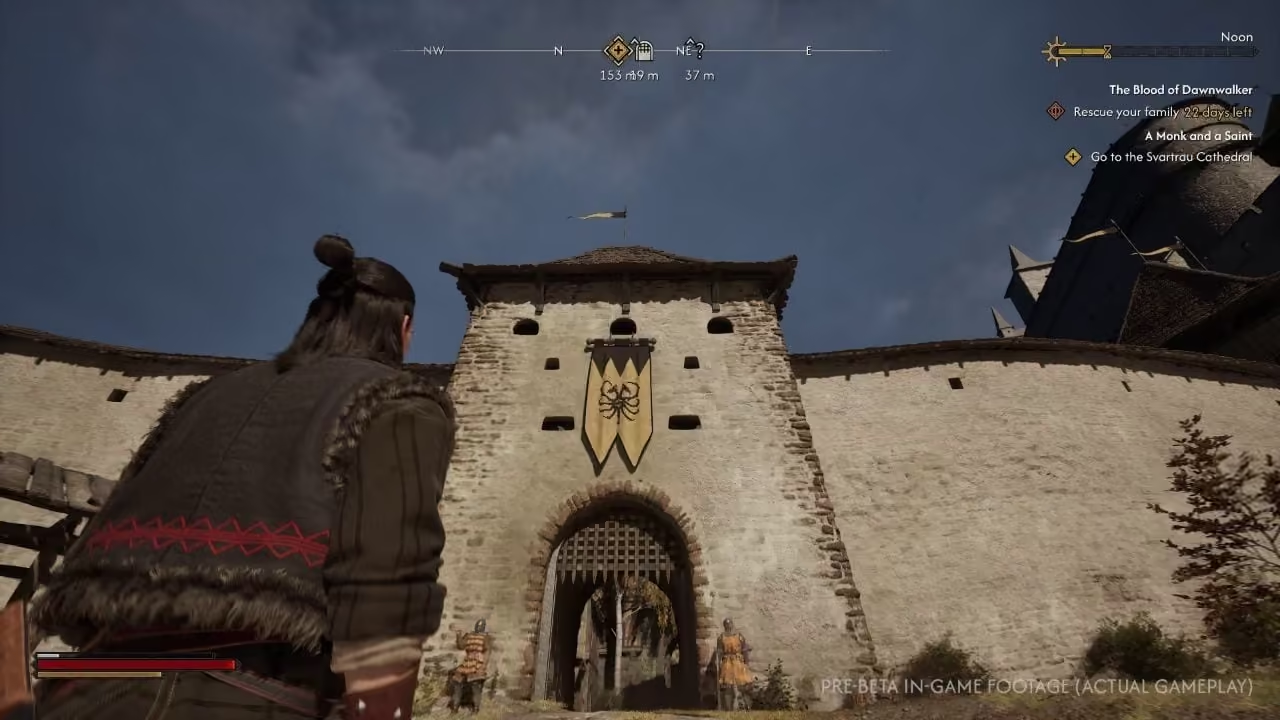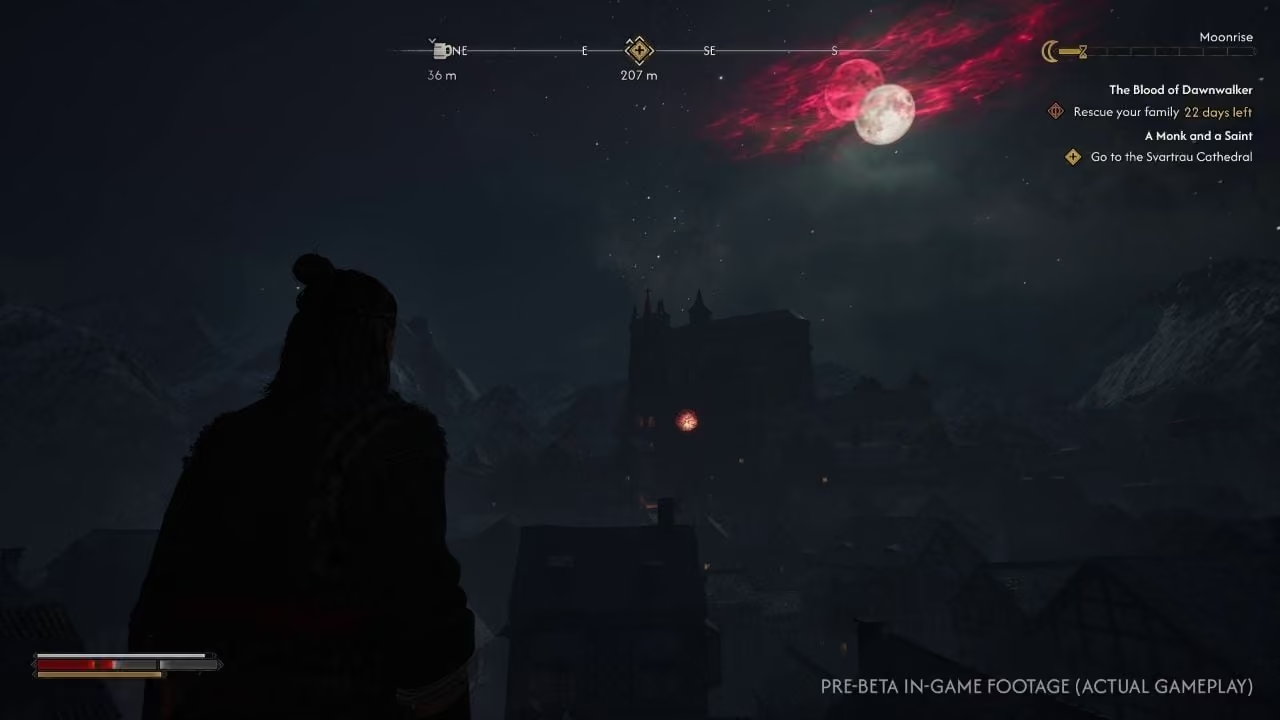
Short answer
No. Exploration and ordinary combat do not continuously use the 30-day story budget. Narrative time advances at marked quest completions, some dialogue choices, other specific actions, and deliberate day/night changes.
Key facts
- Walking and scouting do not run a real-time clock
- Combat does not spend time by itself
- The burning-house example stays active while you investigate
- Hourglass prompts identify actions that advance the world
- Form changes can carry a time cost
You can stop and explore
Dawnwalker does not turn ordinary open-world movement into a real-time race. The official gameplay recap uses a burning-house example: the situation remains available while Coen investigates because the internal clock has not advanced at a cost-bearing checkpoint.
This gives you room to look for alternate entrances, read the environment, gather herbs, study an enemy, or travel to a landmark without losing narrative time simply because the player took longer.
The boundary is the marked commitment
Some activities trigger automatically during exploration. Watch the flashing Time Bar before engaging; a confirmation dialog may not appear.
The same applies to dialogue. Ordinary conversations are not automatically time charges, but some choices can move the story forward and are identified accordingly.
| Situation | Safe assumption | What to check |
|---|---|---|
| Roaming a forest or village | No continuous time use | Whether entering or finishing a nearby activity shows an hourglass |
| Fighting an enemy | Combat seconds do not tick the campaign clock | Whether the fight completes a cost-bearing objective |
| Investigating a clue | Take the time you need | The prompt attached to the final decision |
| Switching form | Can advance time | Whether the day/night change is worth the new route |
Use free exploration to reduce expensive mistakes
Because scouting is free in narrative-time terms, exploration can improve later choices. You can learn the terrain, find a route that suits the current form, identify a settlement or tower, and prepare for combat before spending a marked segment.
Free does not mean consequence-free. Coen can still fight, steal, harm characters, raise Infamy, or alter relationships while roaming. The clock rule and the world-reaction systems are separate.
- Scout entrances before choosing day or night.
- Use landmarks and towers to understand the area.
- Separate the cost of travel from the cost of finishing the objective.
- Avoid criminal or hostile actions if your route depends on low Infamy.
Do not assume every open-world action is free
The safe rule is that time advances only through signposted activities—not that every optional action is guaranteed to be free. If a choice or activity displays an hourglass, believe the current interface even if the objective began as exploration.
The cost can also be part of choosing to move from day into night. A nighttime shortcut may save difficulty or open a clue while still spending narrative time to reach that form.
Common questions
Can I explore for hours without losing story days?
Yes. Real-world exploration time does not continuously consume the narrative budget.
Can a quest objective still spend time after free exploration?
Yes. The final or marked step can carry an hourglass cost even when scouting the area was free.
Does fast travel use time?
Publisher sources do not state a universal rule, while one August 31 launch review reports no time notch for fast travel. Follow the current game's prompt if it shows a special cost.